
Dr. Georgi Popov, CSP, SMP, QEP, ARM, CMC, FASSP, FAIHA
University of Central Missouri
Introduction
As stated in Volume II, Issue II of SHIFT, exposure to vibration is common in the construction industry. In fact, tasks in the construction industry have some of the highest exposures to single-point vibration and whole-body vibration (WBV). One of the most common conditions associated with WBV exposure is musculoskeletal disorders (MSD). Additionally, hand-arm vibration (HAV) is recognized as a significant health hazard in the construction industry. Using vibrating power tools like rammers/soil compactors, jackhammers, grinders, impact drills, and many other powered hand-held tools can lead to Hand-Arm Vibration Syndrome (HAVS), which is a permanent, disabling condition affecting nerves, blood vessels, muscles, and joints, causing numbness, tingling, loss of grip, and pain. This requires control measures to reduce the risk to levels considered as low as reasonably practicable (ALARP).
This Best Practice Guide, a collaborative effort by researchers from Keene State College and the University of Central Missouri, presents examples of best practices for WBV and HAV exposure assessment and risk management.
Such occupational safety and health risks are listed in Domain 6 of BCSP's ASP 11 Blueprint and Domain 1 of the CSP blueprint.
Regulatory Guidance and Exposure Measurement
The U.S. Occupational Safety and Health Administration (OSHA) doesn't have a WBV/HAV-specific standard; citations often fall under Section 5(a)(1) of the OSH Act (the "General Duty Clause"), requiring employers to provide a workplace free from recognized hazards likely to cause death or serious harm. OSHA citations sometimes reference guidance from documents such as the OSHA Woodworking eTool on Vibration, the Centers for Disease Control and Prevention (CDC) National Institute for Occupational Safety and Health (NIOSH) Criteria Document (83-110), and ergonomic guidelines, as evidence of “known hazards” that an employer has failed to control. These risks stem from vibrating tools, which can lead to so-called "white finger" syndrome, also known as Raynaud's phenomenon or vibration-induced white finger (VWF).
However, in the UK, the Health and Safety Executive (HSE) has implemented the “Control of Vibration at Work Regulations.” WBV and HAV calculators are also freely available from the UK HSE.
Most modern WBV and HAV measurement systems include built-in software that performs Daily Vibration Exposure (A(8)) calculations and displays vibration magnitude. HAVS magnitude refers to the intensity of vibration from power tools (acceleration), measured in meters per second squared (m/s2).
Practical Application of WBV and HAV Tools
The following videos provide several practical examples of HAV and WBV case studies and evaluations. Let’s concentrate on WBV and HAV. There are so many other safety and IH issues, but we can’t address them all here.
WBV
Download the WBV Tool.
HAV
Download the HAV Tool.
Obviously, the risk levels in these scenarios are unacceptable. Therefore, it is advisable to implement the Hierarchy of Risk Treatment to reduce the risk to ALARP levels. As demonstrated, the application of higher-level treatments and the use of multiple or ‘layers of controls’ are more effective risk reduction strategies.
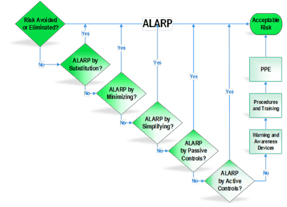
FIGURE 1: ANSI/ASSP Z590.3-2021
Developed by: Bruce Lyon | CSP | P.E. | SMP | ARM | CHMM | FASSP and
Dr. Georgi Popov, CSP, QEP, SMP, ARM, CMC, FASSP, FAIHA